
Why a light, bulky box can be assessed differently from a compact one, with a worked calculation.
Actual weight and occupied space answer different questions
Actual weight is the packed parcel’s reading on a scale. Volumetric or dimensional weight converts its outside volume into a comparison weight. Carriers use the latter to reflect space occupied by bulky packages. The terms are not two ways of measuring the same physical weight.
Some services compare both results and assess the larger figure. Product-specific rounding, minimum charges and handling rules can also apply. A mathematical result alone is not a quote.
The calculation, with units visible
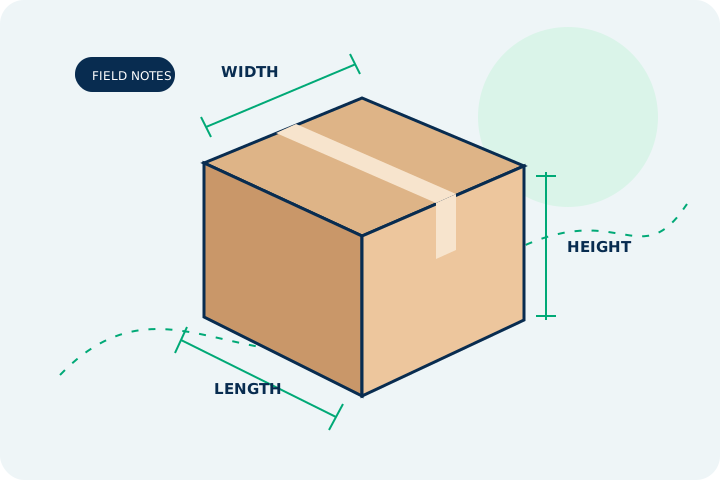
For dimensions in centimetres, multiply length × width × height, then divide by the applicable divisor. The divisor is not universal. Check the actual service, route and account terms before using a number in a shipping decision.
Worked example: 50 × 40 × 30 = 60,000 cm³. At a divisor of 5,000, the volumetric result is 12 kg. At 6,000 it is 10 kg. If actual packed weight is 4 kg, both examples exceed actual weight. These are calculation scenarios, not carrier prices.
Volumetric weight calculator
Use the outside dimensions of the sealed parcel. These results explain measurements; they do not confirm carrier eligibility or a shipping price.
The default 5,000 divisor is an example, not a universal carrier rule. Change it to the value specified by your service. Check the actual product’s rounding, restrictions and measurement method.
Calculate each piece separately
A multi-parcel order needs the dimensions and weight of each box. Averaging a small carton and a bulky carton can hide the latter’s space assessment. Keep the parcel count alongside the order and match each label to the correct box.
Do not multiply one box’s dimensions by the number of cartons unless every carton really has the same dimensions. An extra protective outer box changes the result and should be measured again.
Reduce wasted space without reducing protection
A smaller suitable carton can reduce empty space, but squeezing a fragile item against a box wall is not a sensible saving. Leave room for appropriate protection and stop contents moving. Test the packed shape rather than selecting a box from its nominal internal size.
DHL Express, UPS, FedEx and Evri publish their own dimensional guidance. Use those primary sources to confirm the applicable method. Our calculator exposes its divisor and never infers service availability.
Questions worth clearing up
Why does a larger divisor produce a smaller result?
The outside volume stays the same while the conversion factor changes. A 60,000 cm³ parcel divided by 5,000 gives 12 kg; divided by 6,000 gives 10 kg. The lower scenario result does not mean you are entitled to choose that divisor for a service.
Can I calculate the whole order using an average box?
Not reliably if the parcels differ. Calculate each physical piece from its own measurements and apply the relevant product rules. An average can hide one particularly bulky box, even when the total order weight is correct.
Primary sources & editorial review
Reviewed on 7 November 2026. Rules can change; check the specific product, destination and current official guidance before sending. This independent explanation is not a quote or a guarantee.
- DHL Express — preparing your shipment
- UPS UK — parcel dimensions and weight
- FedEx UK — dimensional weight
- Evri — parcel size and weight guide
Spot something that needs updating? See our contact information and editorial approach.