
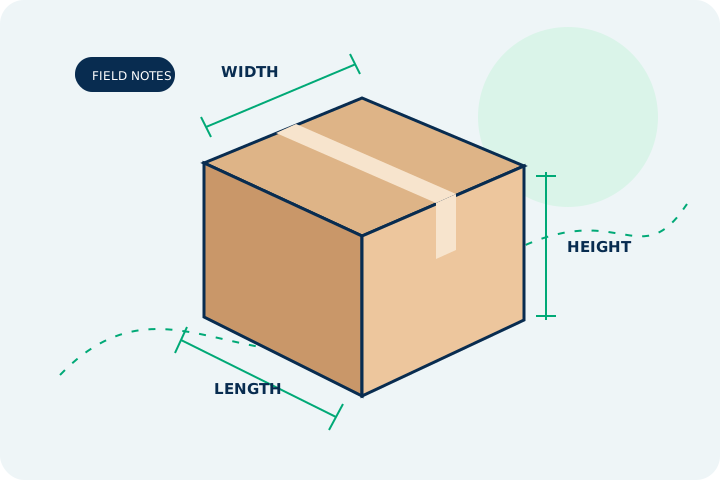
Measure the sealed parcel at its widest points and keep units consistent.
Measure the package you will actually hand over
Close and seal the final packaging first. Measure outside edge to outside edge, including bulges, handles and protrusions. For an irregular object, imagine a rectangular box around its extreme points. A soft bag should not be compressed into a smaller measurement it will not keep in transit.
Use a tape measure and suitable scales. Record the raw measurements before applying the selected service’s rounding rules. Estimating from the item’s retail listing can miss the weight and size added by the shipping packaging.
Keep length, width and height distinct
The longest side is normally called length when using length-and-girth calculations. The other two dimensions form the cross-section. A 60 × 40 × 30 cm box has a 140 cm girth and a 200 cm length-plus-girth result. Those numbers describe different things.
A service asking for three dimensions should receive all three. Entering “130 cm total” in a longest-side field does not provide the same information.
Parcel measurement calculator
Use the outside dimensions of the sealed parcel. These results explain measurements; they do not confirm carrier eligibility or a shipping price.
Girth is twice the sum of the other two sides after identifying the longest side. Check the actual product’s rounding, restrictions and measurement method.
Use the packed weight
Include the carton, cushioning, tape, label and any protective wrapping. Check the scale’s capacity and resolution. If it cannot accurately read a small parcel, use another scale rather than guessing a result from a visibly fluctuating display.
Keep grams and kilograms clear: 1,250 g is 1.25 kg. Avoid typing 1250 into a kg field. Keep centimetres and millimetres clear too: 400 mm is 40 cm.
Check the selected product after measuring
Royal Mail’s small and medium formats use specific outside measurements and packed-weight limits. Other carriers may also consider length plus girth or dimensional weight. Meeting one limit does not prove that the contents or destination are accepted.
Keep a photo of the box on the scales and, where useful, alongside the tape measure. These records can help explain your figures if a carrier later reports a different measurement.
Questions worth clearing up
What is the difference between millimetres and centimetres?
Ten millimetres equal one centimetre. A dimension of 400 mm is 40 cm, not 400 cm. Write the unit beside the measured number before entering it into a form, and check the field label rather than relying on memory.
Should I enter a convenient rounded-down measurement?
No. Preserve the measured outside dimensions and packed weight, then follow the selected service’s rounding instructions. Rounding down to enter a cheaper category can misdescribe the physical parcel and lead to a correction or rejection.
Primary sources & editorial review
Reviewed on 7 November 2026. Rules can change; check the specific product, destination and current official guidance before sending. This independent explanation is not a quote or a guarantee.
- Royal Mail — how to weigh and measure a parcel
- Royal Mail — size and weight guide
- UPS UK — parcel dimensions and weight
Spot something that needs updating? See our contact information and editorial approach.