
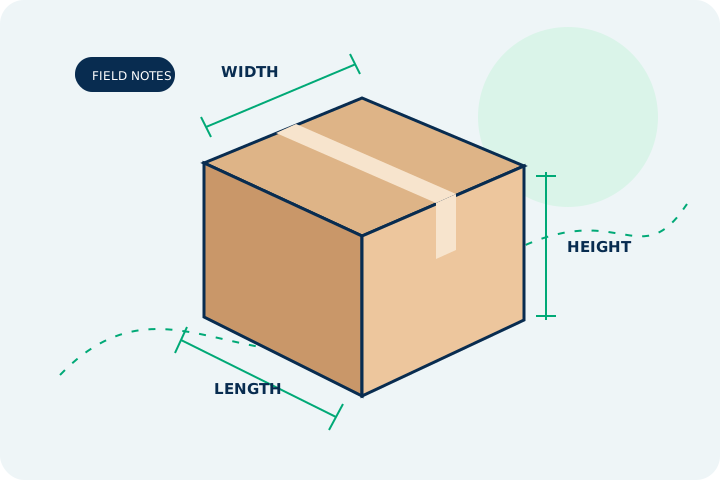
A packing-bench workflow for measurements, item records, documents and a clear handover. Use the country guide for destination context.
Before packing: settle the route and contents
Use the dedicated Italy country guide to prepare the full destination and the border questions. This checklist focuses on the physical dispatch workflow for a parcel leaving Great Britain. Northern Ireland movements need a separate check.
Identify the goods and verify that the chosen carrier accepts them on this route before buying materials or postage. Keep the acceptance decision separate from compensation exclusions. Do not assume an everyday domestic item can travel internationally under the same conditions.
At the bench: finish the box before measuring
Pack the contents securely, immobilise movement and seal the outer packaging. Record the outside dimensions and packed weight. If you add another protective layer, repeat those measurements instead of keeping the earlier readings.
Worked scenario: a 45 × 35 × 20 cm carton has a 31,500 cm³ volume. A 5,000 divisor gives 6.3 kg as a volumetric comparison. If the packed weight is 3 kg, those are different preparation figures. This is arithmetic, not a rate or an assertion about which service will accept the box.
On the paperwork: reconcile each item
Make a specific contents list and keep quantities, values, currency and origin consistent with the order record. For example, two cotton T-shirts valued at £15 each give £30 of goods. The phrase “gift” or “sale” explains purpose; it does not replace the goods description.
Check the actual country of origin rather than copying the dispatch country. Ask the provider which declarations, supporting invoice and product data it requires under current rules. Do not invent a commodity code or identifier simply to fill a mandatory field.
| Check | Keep consistent |
|---|---|
| Quantity and values | Unit value × quantity agrees with the total |
| Currency | Clearly identified on the goods record and documents |
| Purpose | Actual sale, gift or return; never changed to seek different treatment |
| Origin | Actual origin information, not an assumed UK manufacture |
| Parcel count | Physical cartons agree with the intended labels |
At handover: keep the evidence
Match the correct label to each physical carton and attach any documents as the provider instructs. Remove old routing labels and keep the barcode clear. Confirm the location or collection arrangement and any label-printing requirement before travelling or waiting for a driver.
Retain the handover receipt or collection evidence with the contents record and declaration. A created label is not proof that the parcel has left your possession.
To the recipient: explain the next step
After physical handover, share the reference securely and explain how the recipient can follow official tracking or respond to legitimate customs questions. Agree who is responsible for applicable import or handling charges; do not promise a tax outcome from a generic online guide.
A useful message states what has actually happened: “The parcel has been handed over; here is the reference.” Avoid claiming a guaranteed delivery day unless that commitment genuinely belongs to the purchased service. SelectaParcel does not currently create that booking.
Shipping preparation checklist
Check the steps as you prepare. Your checklist stays in this page only; we do not store it.
Questions worth clearing up
Does a valid-looking CAP verify the recipient address?
No. Format validation only checks the structure of a postal code. Confirm the full Italian address with the recipient, including local building, apartment or access details needed for delivery, and check the exact route with the provider.
Should a returned purchase be declared as a gift?
No. State the actual reason for movement and preserve the original order/return evidence. Ask the selected provider which documents and explanation it requires. Changing the purpose to seek a different import treatment is not appropriate.
Primary sources & editorial review
Reviewed on 7 November 2026. Rules can change; check the specific product, destination and current official guidance before sending. This independent explanation is not a quote or a guarantee.
- HMRC — sending post or a parcel abroad
- European Commission — current low-value import guidance
- Royal Mail — sending to Italy
- DHL Express UK — prohibited and restricted items
Spot something that needs updating? See our contact information and editorial approach.